
Why Outsourced Mop Service Beats In-House Laundering
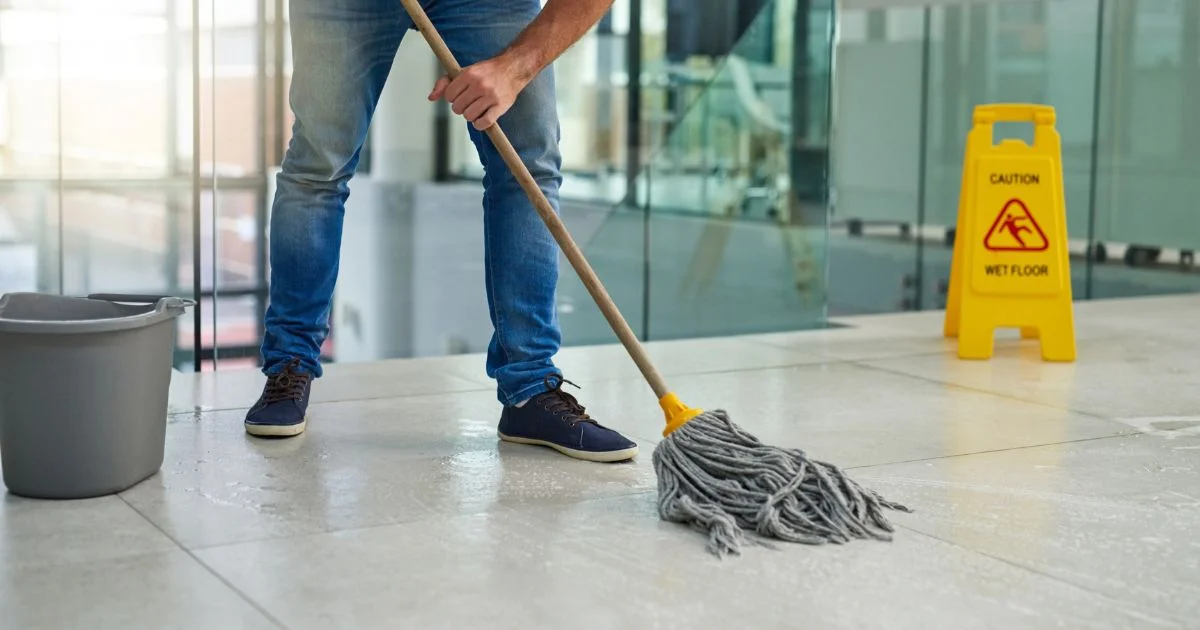
The mop that cleaned the bathroom floor this morning is probably still damp. It went back in the bucket, or got hung in the closet, and it'll be used again this afternoon without anyone checking how long it's been in rotation.
By the time it smells bad enough to flag, it's likely been spreading bacteria across floors that looked clean for weeks. That's not a worst case. That's the default operating condition for most businesses handling mop maintenance in-house.
What Happens to a Mop Between Uses
A wet mop head left in a bucket doesn't dry out in a few hours, not in a closed space. It stays damp, and damp organic material grows bacteria fast. Cleaning tools that aren't washed, dried completely, and stored properly between uses pick up and redistribute what they were supposed to remove.
Most facilities underestimate how quickly a mop head becomes the problem rather than the solution. A mop head that looks clean has often already picked up more than it can hold. At that point, it's redistributing what it collected on the last pass, not capturing anything new.
The other problem is replacement cycles. Most facilities swap mop heads when someone complains, or when the head is visibly falling apart. No set schedule, no tracking, no standard.
Staff make calls based on appearance, which is a poor way to judge whether a mop is still capturing dirt or just moving it around.
Wet mops lose their effectiveness before they look worn. The fibres compact over time, absorption drops, and the mop starts pushing moisture across the floor instead of pulling it up. A floor mopped with a spent head isn't clean. It's wet, and whatever was on that floor is still there.
The Laundering Problem Most Facilities Don't Talk About
In-house laundering sounds like a fix. Run the heads through a washer, dry them, put them back in service. In practice, most businesses don't have equipment that does this right, and the ones that do often skip proper drying because it takes too long.
A mop head washed alongside rags, cloths, or anything else that touched a floor can pick up cross-contamination in the wash cycle itself. Temperature matters, too. Most light commercial washers don't reach the heat needed to deal with what a mop head builds up over a standard service interval.
There's also the training gap. Most staff doing the laundering aren't trained for it, and they're working with equipment and processes that weren't built for the job. It shows up across Southern Ontario — Cambridge restaurants, Waterloo warehouses, London medical clinics — mop maintenance handled informally, no standard behind it.
The cost adds up in ways that don't show on a single invoice. Washer wear, hot water, staff time, storage space for heads at various stages of clean and dirty — none of it appears as a line item until someone runs the actual number, and when they do, the cost of in-house laundering usually comes as a surprise.
The risk is harder to price. Under Ontario law, slips, trips, and falls are among the most common sources of workplace injury claims — and employers who can't demonstrate they took reasonable precautions face direct liability exposure. A contaminated mop in a food prep area or a medical clinic isn't just a cleaning failure; it's the kind of gap that shows up in a WSIB claim or an OHSA inspection.
What Outsourced Mop Service Actually Changes
The model is straightforward. Clean mops arrive on a fixed schedule, spent ones get picked up, and the business never touches the laundering process. There's no tracking wear cycles, no storage to manage, no judgment calls about whether a head is still usable. The mop in the bucket is always a clean one.
Professional mop cleaning uses industrial equipment. Sustained temperatures, the right chemistry, proper drying cycles. Most facilities can't replicate that internally, and the gap between what in-house laundering achieves and what professional cleaning achieves is where contamination persists.
The heads that come back aren't just rinsed. They're restored to a condition that captures dirt and moisture rather than redistributing it across the floor. For food service, healthcare, and any facility where floor hygiene affects regulatory compliance, that distinction matters well beyond convenience.
Under Ontario's Occupational Health and Safety Act, employers are required to take every reasonable precaution to protect workers — and the Ministry of Labour lists poorly maintained equipment and unsecured mats explicitly as slip, trip and fall hazards. A documented service schedule creates a verifiable record. Informal in-house laundering doesn't.
Treated Dust Mops Are a Different Problem
Most of what's above applies to wet mops. Treated dust mops work differently. The treatment is what makes them effective, and that treatment breaks down over time, regardless of how clean the head looks.
A dust mop past its service life isn't just less effective. It releases the dirt it was supposed to hold. That's the opposite of cleaning. Professional cleaning for treated dust mops restores the treatment, not just the cleanliness of the fibres.
A regular wash cycle doesn't do that. Businesses that launder treated dust mops the same way they'd launder a wet mop usually end up with a head that looks fine but performs poorly. The underperformance rarely gets connected to the laundering method; it just shows up as floors that don't stay clean.
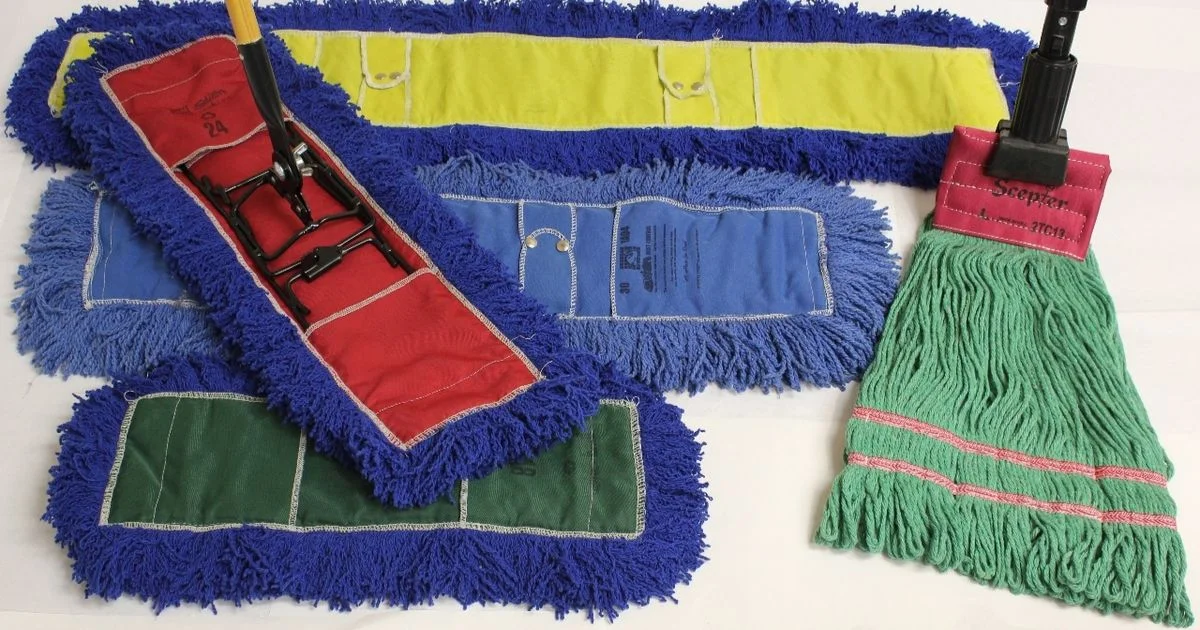
If you want to know how treated dust mops differ from wet mops in day-to-day use, how treated mops capture dirt versus what a standard mop head actually does is worth reading before deciding which type goes where in the facility.
What Mops Can't Fix on Their Own
A clean mop handles the floor, but floor hygiene is only part of the picture in most commercial facilities.
The bigger gap is above floor level. Counters, surfaces, equipment — anything staff wipe down with a cloth that also touched a floor or a restroom. That's where germs move from one area to the next without anyone noticing.
Cloths are the fix. Assign specific cloths to restrooms, the kitchen, and common areas. This way, staff always know where each cloth belongs; no guessing, no mixing zones up.
Microfiber is the right material for this. The fibres are small enough to trap germs rather than push them around. One cloth holds about seven times its weight in liquid. Cotton rags wear out fast; a good microfiber cloth lasts around 500 washes before it needs to be swapped out. They also work without heavy cleaners, which matters for any business trying to cut product costs or keep harsh chemicals out of the drain.
For businesses already running a mop program, Swan supplies microfiber cloths on the same service schedule — clean cloths delivered, used ones picked up; no in-house laundering required. Floor hygiene and surface hygiene are connected problems. Fixing one and leaving the other alone only gets you partway there.
When You're Already Running a Mat Program
For facilities that rent mats on a professional service schedule, adding mop service through the same vendor removes a coordination problem. One schedule, one invoice, one contact. Mats, mops, and depending on the facility, microfiber cloths and hand sanitizer — all on the same rotation.
The practical benefit isn't just convenience. It's that service intervals get aligned. A mat program running bi-weekly alongside a mop program running on whatever informal cycle the cleaning staff manages creates gaps. When both run on the same schedule, floor hygiene becomes predictable. Right now, for most facilities, it's reactive.
Property managers running residential buildings see it most clearly — a lobby mat in good shape, mops managed informally, and contamination still moving past the entrance and onto the main floor every day.
For more on how mat and mop programs work together in high-traffic settings, floor mat and mop solutions for commercial and manufacturing environments covers the combined approach in detail.
Where In-House Makes Sense
Low-traffic facilities with simple cleaning needs and a single mop station might not need a service program. If a mop gets used twice a week, gets properly laundered each time, and there's no food service or healthcare component involved, the economics of outsourcing may not work in their favour.
That changes fast with volume. More mop heads, higher traffic, any regulatory requirement to document cleaning protocols — at that point, in-house laundering is carrying more risk and cost than most facilities have worked out. The contamination risk alone is worth a conversation.
Some facilities are surprised to find the rental cost is close to what they're already spending once staff time and equipment wear get added in. Others find the gap is wider and the switch is easy to justify. Either way, the number is worth knowing.
Think about what in-house mop maintenance actually involves. Someone has to wash the heads, dry them, store them, and track when they need to be swapped out. In a small operation, that might take 20 minutes a week. In a larger facility with multiple mop stations, it adds up fast. That time has a cost, even if it doesn't show up on an invoice.
When you add washer use, water, and the heads that get thrown out before their time because nobody's sure if they're still good — the real cost of in-house laundering is usually higher than it looks on the surface.
Swan's mop rental service picks up spent heads, cleans them professionally, and returns them on a fixed schedule. No storage, no laundering, no tracking. If the current process is producing floors that don't stay clean between cycles — or costing more than expected — reach out to us to put together a mop program that fits the facility's traffic and schedule.